

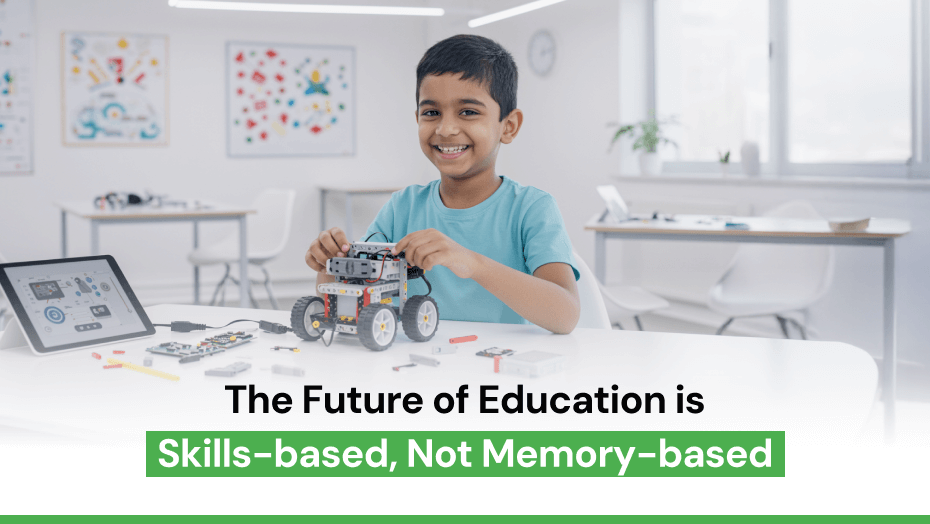
The traditional educational system is not enough anymore! As a parent, you know this is the hard truth. You can relate to the struggles you experienced because your education lacked the practical skills to cope with the dynamic working environment. That is why, deep down, you hope your child’s education will be different, one that is not just about marks or grades but about equipping children to face the challenges of the modern world.
However, turning that hope into reality isn’t easy. Our education system is still largely rooted in traditional, memory-based learning, where marks matter more than skills. Making this shift to skill-based learning isn’t as simple as adding a few new subjects. It’s about overcoming school resistance, rethinking teacher training and how schools run, and how students are prepared for life beyond the classroom.
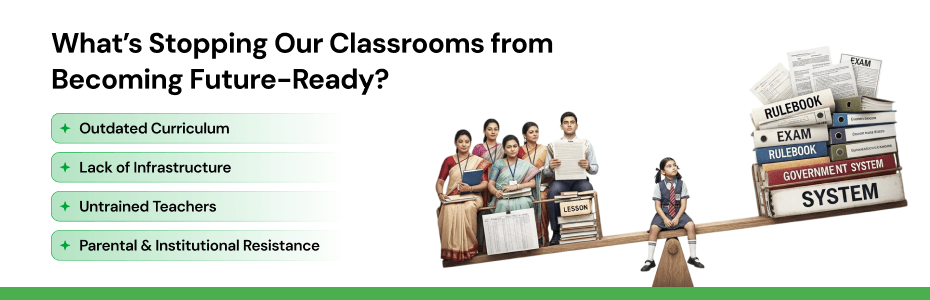
One of the main barriers to education reform is the tug-of-war between teachers and the system. Both want what’s best for students, but often they’re pulling in opposite directions.
What’s holding us back?
Lack of technology implementation and adding co-curricular activities to the educational framework are often avoided by many schools.
According to the Observer Research Foundation,
- Only 57.2% of Indian schools have working computers
- Just 53.9% have internet access
- Less than 18% have spaces like arts and crafts rooms for hands-on learning
These numbers show how much your child is still missing out, making it difficult for them to bridge the skill gap necessary when stepping into the real world
Why Skill-Based Education is No Longer Optional
Here is why our educational system needs to transform:
a) Changing Job Markets Demand New Skills
The job market your child will enter is unrecognizable from what it was even 10 years ago.
- Traditional roles are vanishing due to automation and AI
- Emerging industries — tech, healthcare, digital marketing — require flexible, cross-functional skill sets
- Essential skills now include: coding, data analysis, project management, digital finance, and more
Memory-based education simply can’t keep up with this pace of change.
b) Shift from Theoretical Learning to Practical Learning
Employers don’t care about your score in geography. They are more interested in your ability to solve real problems. They want people who can collaborate, adapt, think critically, and communicate effectively. Employers today are not looking at your child’s exam results.
They’re looking for:
- Real-world problem solvers
- Team players
- Adaptable thinkers
- Communicators who can work under pressure
A skill-based curriculum nurtures these traits, preparing students not just to learn, but to apply.
c) Core Characteristics of Skill-Based Learning
Let us look at what this actually looks like in the classroom:
- Case studies that simulate real-life decisions
- Continuous feedback instead of just end-of-term results
- Adaptability: lessons that evolve with the world outside school
The Core Battle: Teachers vs. Systems
Despite the promise of skill-based learning, most schools are stuck in a battle — teachers vs. systems.
Both want what’s best for students. But both are held back in different ways. Let us look at the common pitfalls in skills-driven curriculum reforms.
1. Challenges in Implementing Skills-Based Curriculum
Restructuring how we teach is not easy. It requires:
- Significant changes to the curriculum, which take a lot of time and money
- Working closely with industry experts, something most regular schools don’t usually do
- Getting approval from school boards, principals, and management, who are often not open to new ideas
Many schools still consider skill subjects as “optional extras” rather than a core part of education.
2. The Barriers Created by Education Systems
Our systems are focused on academic scores, not practical skills.
This leads to:
- Overemphasis on board exam results
- No space or time in the schedule for skill subjects
- Poor infrastructure, such as:
- Limited devices or digital access
- No dedicated labs for experimentation
- Especially problematic in low-income or rural schools
- Limited devices or digital access
Until these barriers to education reform are addressed and resistance to change by educational institutions is overcome, true change remains out of reach.
3. Teacher Training: The Silent Struggle
This is perhaps the most overlooked problem of all. Most teachers have never been trained in:
- Digital tools or platforms
- Emerging subjects like AI, or financial literacy
- Practical, student-led learning methods
They’re trained in theory, not in application. And they often lack support, time, or exposure to change that. Some schools try to fill the gap using external vendors, but this makes skill learning expensive, inconsistent, and hard to scale.
Until we invest in meaningful teacher training, reform will always fall short.
4. Parental & Institutional Resistance
Parents want success for their children, but often define it narrowly as “good marks.”
Here’s what holds back progress:
- Skill-based subjects aren’t seen as important yet
- Parents fear change, especially during board exam years
- Institutions hesitate, worried about rankings, results, and criticism
But here’s the truth: skills are not add-ons. They are the foundation for success.
What Needs to Change: A Future-Ready Approach
To build schools for the future, we need to rethink the entire ecosystem — from classroom to mindset.
a) Skills-First Mindset Across Stakeholders
We need a cultural shift.
- Skills must be seen as essential, not optional
- Boards, schools, teachers, and parents must align on this belief
- Schools should be proud to offer AI, coding, and design thinking, and not hide them behind academics.
b) Investment in Teacher Training & Upskilling
We can’t teach new-age skills with old-school tools.
Here’s what’s needed:
- Regular teacher training (not one-off workshops)
- Industry exposure: so teachers understand the real-world context
- Practical training: so even primary teachers can teach science with home experiments, math through budgeting, or English through storytelling
c) Infrastructure Changes
To teach skills properly, schools need the right spaces:
- Skill labs (CBSE requires all schools to have these by 2027)
- Digital classrooms with internet-ready systems
- Creative spaces like maker labs, innovation corners, and audio-visual rooms
d) System Flexibility for Implementation
We need to reframe what success looks like:
- Stop depending only on board exam marks to measure performance
- Use flexible curricula that mix book learning with real-world skills
- Appreciate students who think creatively, build things, and take initiative — not just those who memorize well
The CBSE already allows skill subjects to replace academic ones in some cases. But more schools need to embrace this.
At 2Sigma School, This Future is Already Here
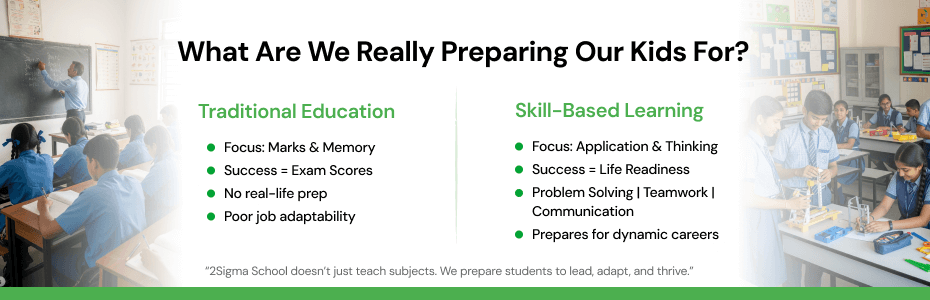
We are not a school — we are an Excellence Program for the future of education.
Here’s what sets us apart:
- Personalized learning paths that are designed around each student
- Focus on life skills like time management, empathy, and decision-making
- Real-world application of math, science, and English through activities, workshops, and projects
- Teachers act as mentors and facilitators, not just instructors
We prepare students not just to learn, but to lead.
Conclusion
True reform isn’t just about adding robotics or coding to the timetable. It’s about empowering teachers, changing how we measure success, redesigning schools, and, most importantly, believing that our children deserve more than just good grades.
At 2Sigma, we’re already building this change. We believe that education reform doesn’t happen in classrooms alone — it happens in mindsets.Ready to reimagine what education can be? Discover how 2Sigma School can help your child grow into a future-ready learner with skills that matter.