
There’s a quiet revolution happening in classrooms around the world. According to a report, 95% of educationists back micro-credentials achieved through skills-based learning for job readiness. This shows that traditional learning, marked by lectures, rote memorization, and one-time exams, is slowly making way for a more dynamic, relevant, and personalized approach: skills-based learning. But here’s the challenge. While the learning itself is evolving, the way we assess it often lags behind. Multiple-choice tests hardly measure collaboration or emotional intelligence. That’s where the need for creating assessments for skill-based learning comes into the spotlight.
The focus of the education framework is shifting. Students are now encouraged to hone practical skills like
- Problem-solving
- Creativity
- critical thinking skills
These are some crucial factors that traditional exams cannot effectively evaluate.
What Is Skills-Based Learning?
The difference between traditional vs skills-based learning is simple.
- The traditional education structure has always been about what to memorize
- Skills-based learning focuses on practical skills and their application
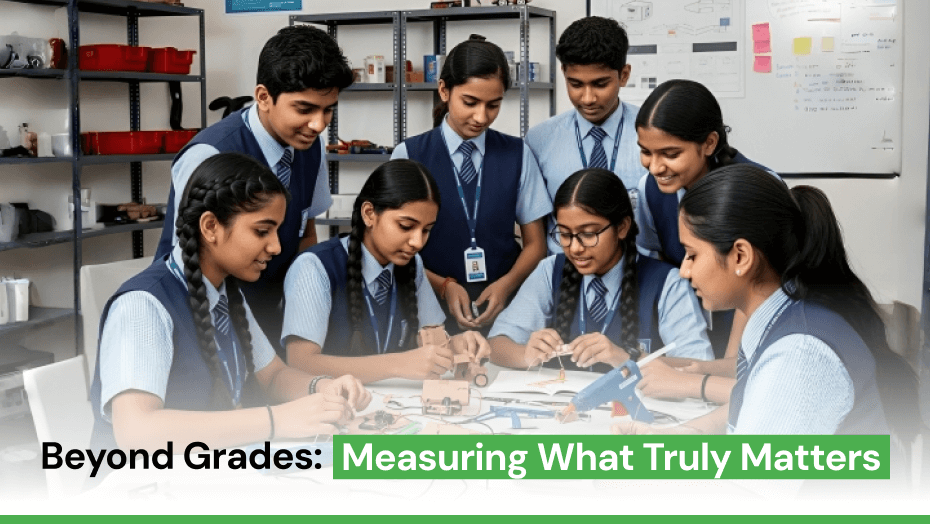
It’s about preparing students for life, not just for the next exam. Instead of passive consumption of information, students actively engage with content through
- real-world projects
- team-based tasks
- Role-plays
- Simulations
This approach nurtures independent and practical capabilities that help them to be ready to tackle real-world issues.
Skill Categories That Assessments Should Focus
When creating assessments for skills-based learning, educators focus on measuring competencies that matter in real life:
- Critical thinking & problem-solving – Analyzing situations, identifying challenges, and finding logical solutions.
- Communication & collaboration – Expressing ideas clearly and working effectively with others.
- Creativity & innovation – Thinking outside the box and bringing fresh perspectives to problems.
- Personal responsibility and reflection – Owning one’s learning journey and making sense of personal growth.
These are not skills you can test with a simple written exam—and that’s the point.
Why Traditional Assessments Don’t Work for Skills-Based Learning
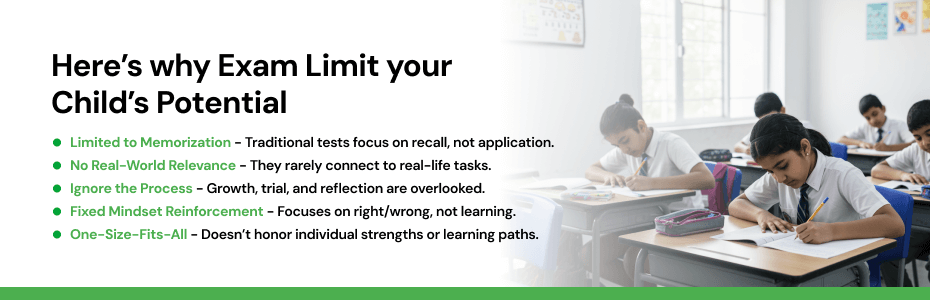
Traditionally, schools have measured how well students are doing by testing how much they can remember with summative assessments. But those kinds of tests don’t always show the complete picture of what kids really know or what they can do. More importantly, they don’t always reflect the real-life skills our children will need when they grow up and enter the workforce.
- Overemphasis on Recall
Traditional pen-and-paper exams are largely about recalling information. But remembering definitions doesn’t equate to understanding, let alone applying that knowledge meaningfully. When the goal is to make your child future-ready, you should look for more than just recall-based tests.
- Lack of Contextual Relevance
One of the significant gaps in conventional testing is its disconnect from real-world scenarios. Students might ace a theoretical exam but struggle to apply that knowledge in practical contexts. That’s why skills-based learning demands assessments grounded in real-life applications.
- Ignoring Process and Growth
Perhaps the biggest flaw in traditional assessment is its obsession with results. Skill-building is a journey—it involves trial and error, iteration, and growth over time. Without assessing the process, we risk missing the bigger picture.
Why Skills-Based Learning Needs a New Assessment Mode
The shift to experiential education has created a need to reassess how we perceive learning. Creating assessments for skills-based learning is not about adding a few extra activities—it’s about rethinking the entire framework.
This new mode values continuous improvement over final answers, active participation over passive consumption, and relevance over repetition. It makes space for student voice and promotes real-world readiness.
Key Principles for Designing Skills-Based Assessments
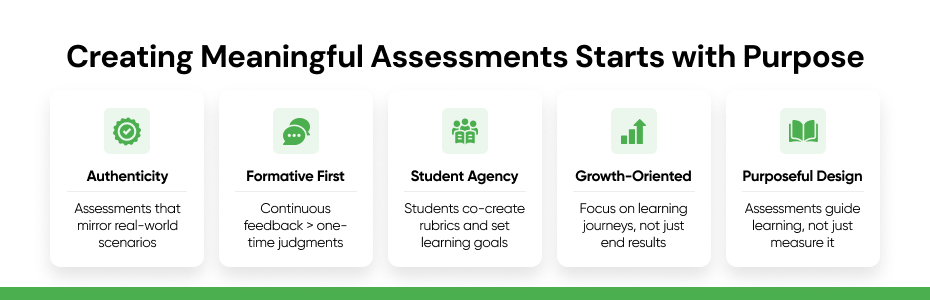
When designing skill-based assessments, it is crucial to keep them fair so everyone has a real chance to shine and be clear about what’s expected. The goal of these assessments is to guide with purpose.
- Authenticity
Summative assessments shouldn’t remain the benchmark. The new structure should reflect real-world challenges. Think presentations, debates, prototypes, and collaborative problem-solving tasks. These mirror what students will face beyond the classroom.
- Formative Over Summative
Formative assessments take centre stage in skills-based learning. These ongoing feedback loops—through peer reviews, rubrics, and reflections—help students refine their abilities throughout the learning process.
- Student Agency
One of the most empowering shifts is giving students a voice in their own assessments. Let them co-design rubrics, choose the format of their submissions, or set personal learning goals. This enhances ownership and motivation.
Assessment Formats That Support Experiential Learning
Some assessment formats, like portfolios, projects, and simulations, help measure both practical skills and real-world experience. Below are some assessment structures that support the broad need for experiential learning.
- Portfolio
Portfolio assessments are a powerful way to track student progress over time, whether digital or physical; portfolios offer curated collections of work that are complete with reflections, iterations, and feedback.
- Performance Tasks
From simulations to role-plays, performance tasks bring learning to life. For example, asking students to “design a sustainable city model” as a group project not only covers academic concepts but also taps into collaboration, creativity, and communication.
- Peer & Self-Assessments
Formative assessments like these promote introspection and critical feedback. When students evaluate their work—or that of their peers—using clearly defined rubrics, they develop a deeper understanding of quality, criteria, and accountability.
- Project-Based Assessments
In this format, students tackle practical challenges through long-term projects. Whether it’s a community initiative, product design, or a research presentation, these assessments allow students to demonstrate integrated skill sets in action.
Why Skills-Based Assessment Will Benefit Students?
Here’s the truth: your child remembers what they experience, not just what they hear. Skills-based assessments fuel
- deeper learning
- stronger engagement
- improved retention
They also prepare students for future workplaces where adaptability, communication, and creative thinking matter more than memorizing textbook facts. Plus, they promote equity because not every student excels in a traditional test, but every student can showcase their strengths in a dynamic format.
How 2Sigma School Embraces Skills-Based Assessment
At 2Sigma School, we don’t just teach—we prepare learners for life. Our commitment to creating assessments for skills-based learning is embedded in every classroom experience.
We integrate practical assessment frameworks throughout the academic journey, replacing one-time judgments with ongoing feedback. We celebrate each student’s unique growth story, and our framework encourages your children to solve real-world problems.
Ready to introduce your child to a modern assessment that is meaningful, measurable, and modern? Discover how 2Sigma School is implementing it.